Ba duan jin: detailed explanation
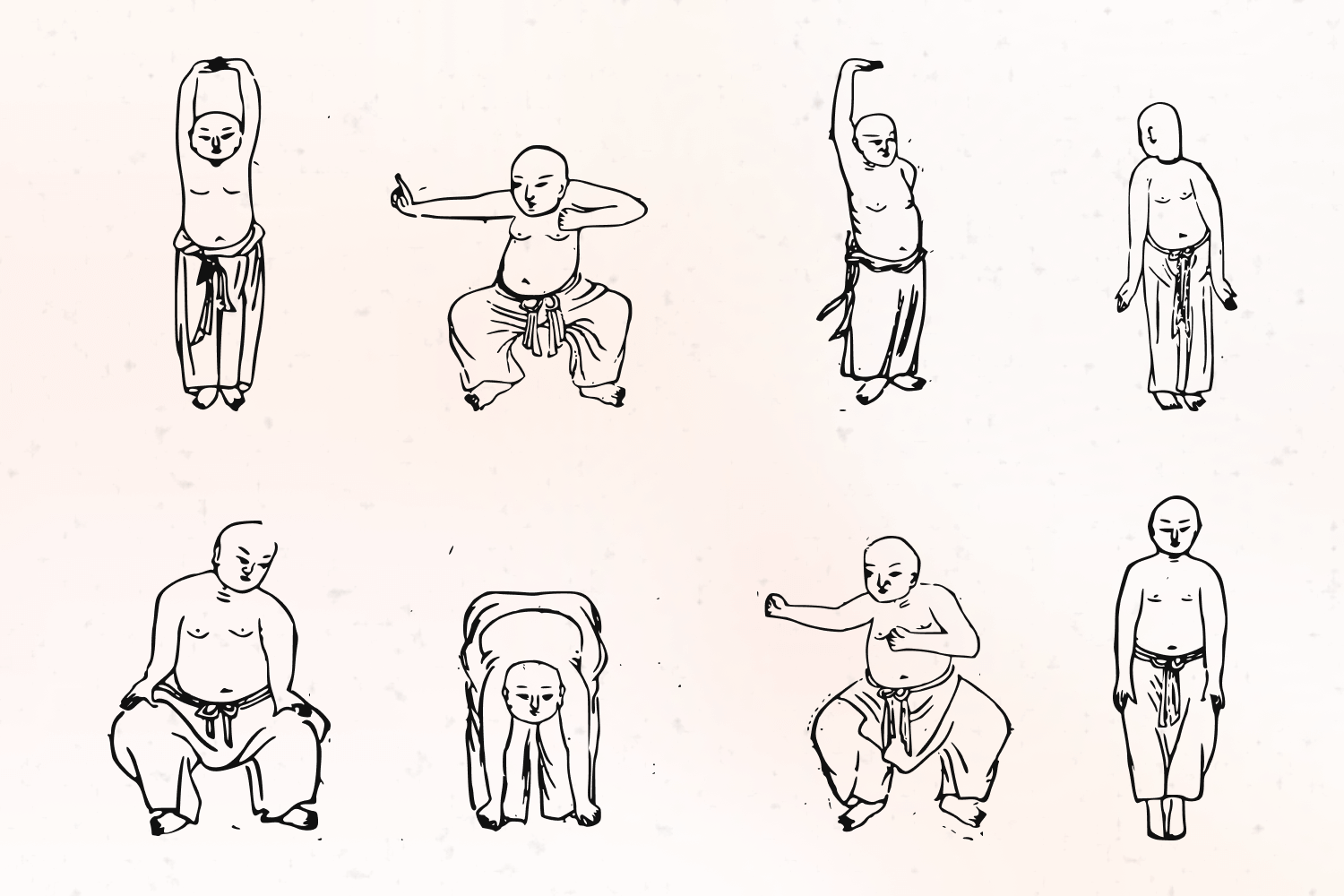
Eight Pieces of Brocade (baduanjing, 八段锦) is one of the most common qigong exercises in the world, which came to us from ancient China. Variously translated as Eight Pieces of Brocade, Eight-Section Brocade, Eight Silken Movements or Eight Silk Weaving
Baduanjin Qigong is based on several Chinese teachings. These include Confucianism, Buddhism, Taoism, Traditional Chinese Medicine (TCM) and – as they would say in China – the knowledge of the sages. Baduanjin is a powerful qigong complex that, if practiced regularly, will help you develop inner strength and good health.
Baduanjin consists of eight bundles of movements (hereafter referred to as steps), they are relatively simple and can be practiced anywhere and at any time. In addition, they are easy to memorize, easy to learn, and easy to practice. The method of training is flexible – the movements can be fast or slow, so there are no age restrictions for classes. The complex is also available to physically impaired people, it is of great benefit and provides significant positive health.
What is the meaning of Baduanjin?
The word “ba” (ba, 八) in Baduanjin literally means eight: the complex consists of eight movements (steps).
The word “duan” (duan, 段) refers to a segment (including time). It also emphasizes that the positive effect of exercise is achieved only through constant practice, in which all movements are included.
The word “jin” (锦) means silk. The Chinese say that the body of the one who exercises acquires the qualities of silk fabric: it becomes flexible, elastic and strong.
The eight successive movements are as graceful and fluid as silk.
In ancient China, this method of bodily enhancement was one of the favorites because of the simplicity and elegance of the technique of performing its exercises.
The Role of Baduanjin in Chinese Medicine
Baduanjin is based on Chan (chan, 禅) Buddhism and the practice of traditional Chinese medicine. The balance and health of the body is achieved in the process of exercise by balancing yin-yang, regulating qi, strengthening tendons, and increasing bone strength. By practicing Baduanjin, you can expect to improve and strengthen health, spiritual growth, and even longevity.
Chinese medicine is based on the knowledge that it is much easier to prevent illnesses than to treat those that already exist
All movements are aimed at stimulating the circulation of air, “qi” (also pronounce as “chi”). Breathing all that affects the movement of “qi” plays an important role in the prevention of disease: according to Chinese medicine, it is much easier to prevent disease than to treat existing ones.
- Both the initial and the final movement of the entire sequence of Baduanjin exercises is the “zero step”: raising and lowering the arms.
- The first two steps help order the energy in the body.
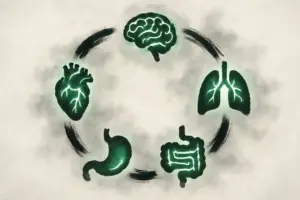
- The third, fourth, fifth, and sixth steps of Baduanjin help to saturate the qi of the internal organs. Their task is to promote the wellness of the body.
- The seventh and eighth steps are strong movements specifically used to control the flow of dantian.
The sequential movements of the Baduanjin complex help achieve internal and external healing of the body, including balancing “cold and heat,” that is, the extremes of yin (cold) versus the extremes of yang (heat). “Cut-off” movements also alleviate pain caused by chronic illnesses.
List of 8 steps Baduanjin
In the list of eight steps of the Baduanjin Complex, each step is described or composed of exactly seven Chinese characters. The uniquely composed hieroglyphs of the complex are amazing in themselves: each of them simultaneously describes the movement itself and the main effect. The description of each step is based on the theory of Chinese medicine, which explains that the main function of Baduanjin is to help regulate the internal organs and to balance the yin-yang.
Baduanjin consists of 8 simple steps that are easy to learn and convenient to practice:
- Two hands reach for the sky to adjust the triple burner (same as triple heater)
两手托天理三焦 (liǎng shǒu tuō tiān lǐ sānjiāo) - Drawing a bow to shoot a hawk
左右开弓似射雕 (zuǒyòukāigōng sì shè diāo) - Raise your hand on each side to adjust the spleen and stomach
调理脾胃须单举 (tiáolǐ píwèi xū dān jǔ) - Turn your head back to prevent illness and injury
五劳七伤往后瞧 (wǔláoqīshāng wǎnghòu qiáo) - Shake your head and shake your tail to get rid of xinhuo symptoms
摇头摆尾去心火 (yáotóubǎiwěi qù xīn huǒ) - Two hands hold the legs to strengthen the kidneys and lower back
两手攀足固肾腰 (liǎng shǒu pān zú gù shèn yāo) - Clench your fists and look fiercely at those around you to improve strength and chi
攒拳怒目增气力 (zǎn quán nùmù zēng qìlì) - Fall seven times on your heels – dissolve all diseases
背后七颠百病消 (bèihòu qī diān bǎibìng xiāo)
Two hands reach for the sky to adjust the triple burner | 两手托天理三焦
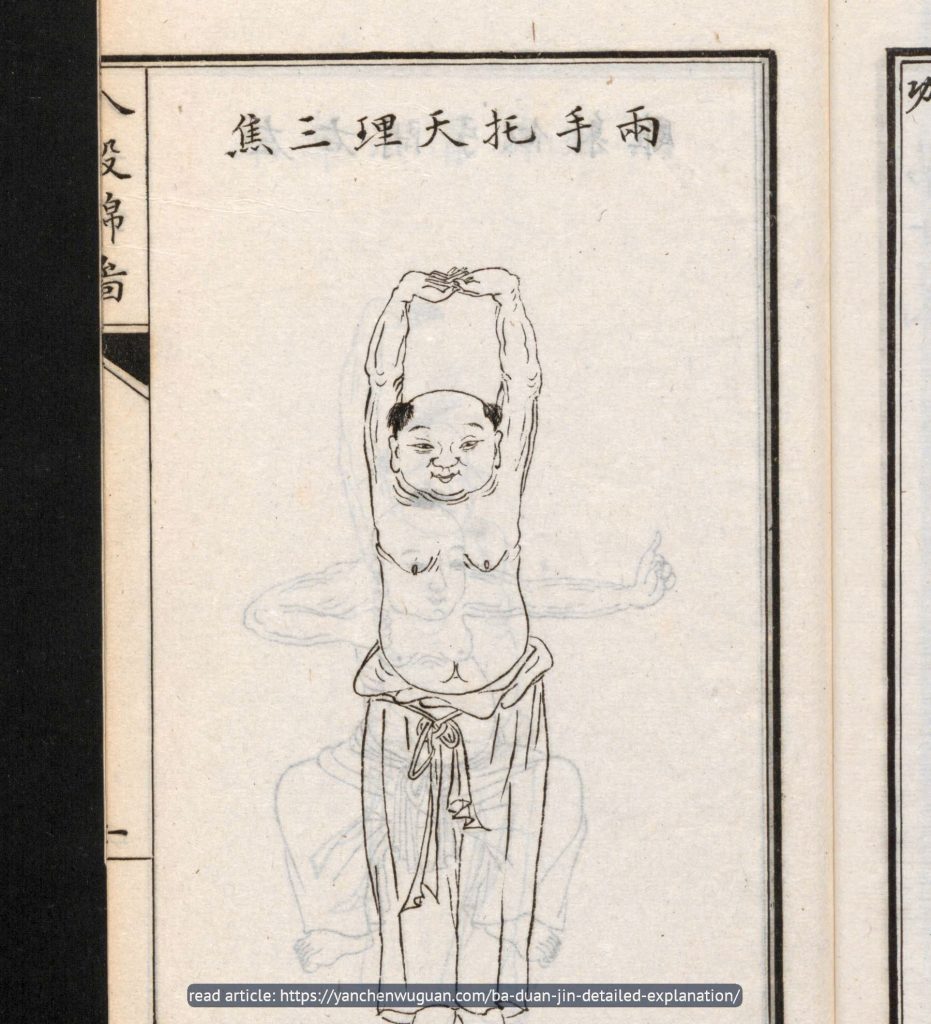
The first movement of Baduanjin is “Two hands reach for the sky to adjust the triple burner. The first part, “two hands reaching for the sky,” demonstrates the technique of performance, and the second part, “adjust the triple burner”, describes the main effect of the movement.
To begin, raise your arms and, following your qi, stretch upward with your whole body. Your feet should stand firmly on the ground. The coordination of these two movements causes your chest to expand and rise. Your waist and back are straight and your body is stretched out. The arms and legs are also fully extended and tensed. This helps to improve circulation and expand the lungs. As a result, your breaths are deeper and you get more oxygen. Your body is literally saturated with qi.
Effect: The first movement relieves fatigue. It brings the triple burner into an active state and regulates the interaction of muscles, meridians, tendons, bones, and internal organs to prepare them for exercise.
Drawing a bow to shoot a hawk | 左右开弓似射雕
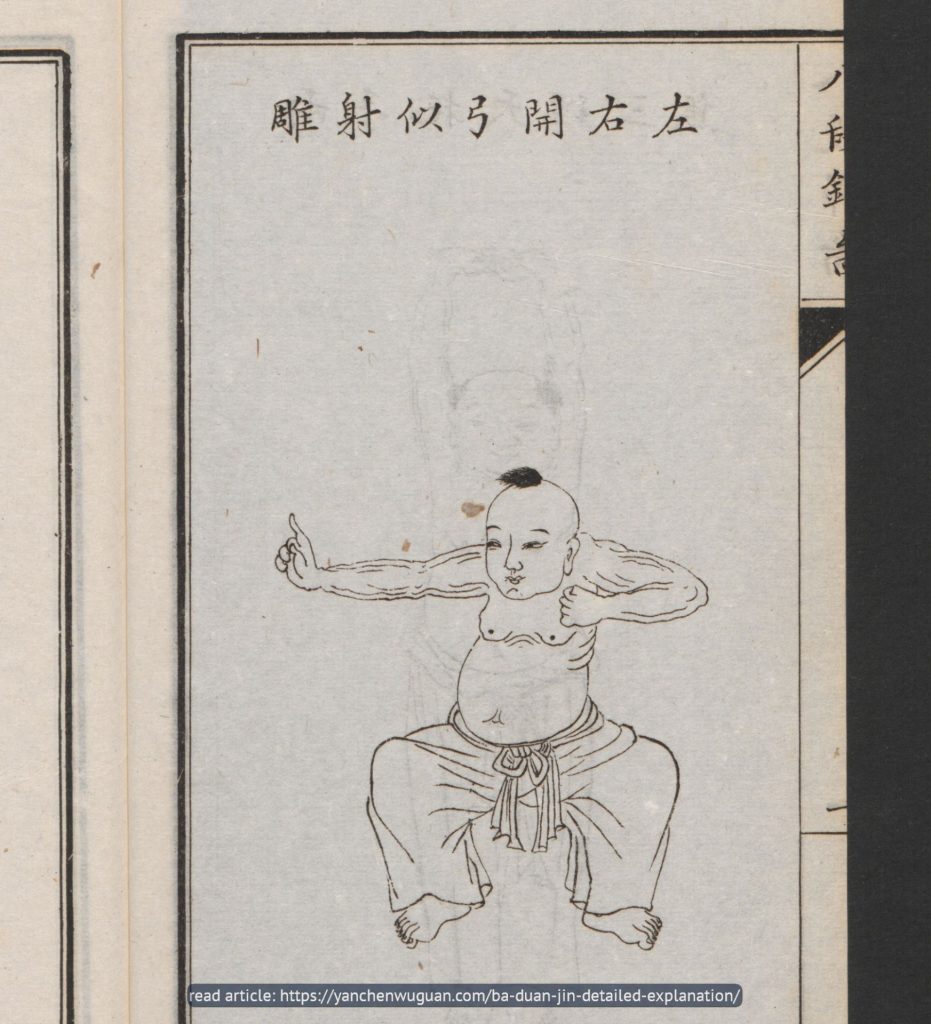
The focus is on regulating the qi flow in the body. This movement is usually thought of as simply using the arm and shoulder to imitate shooting an archer at a bird of prey. However, there is an ancient Chinese proverb that says, “the left liver is the right lung,” confirming that this movement is based on the theory of Chinese medicine. Thus, the true purpose of this movement is to improve the condition of the lungs and liver.
By understanding the purpose of the movement, we can learn some more basics about the theory of Chinese medicine.
In “Drawing a Bow to Shoot a Hawk,” the lower half of the body is in a horse stance, and the hands mimic the action of holding the bow before shooting the bird of prey. By changing the direction of the “bow,” we affect the movement of qi. By pointing the bow to the left, we raise qi toward the liver. When the bow is stretched to the right side, the lungs push the qi downward.
Effect: By practicing this movement, you expand your chest, increase the flexibility of your shoulders and neck, and increase circulation in these areas. You also greatly improve heart and lung function and regulate the upper heater. At the same time, this movement stimulates the three yin and three yang (meridians) of your arm. With frequent practice, the circulation of blood and qi in the body is greatly improved.
Raise your hand on each side to adjust the spleen and stomach | 调理脾胃须单举
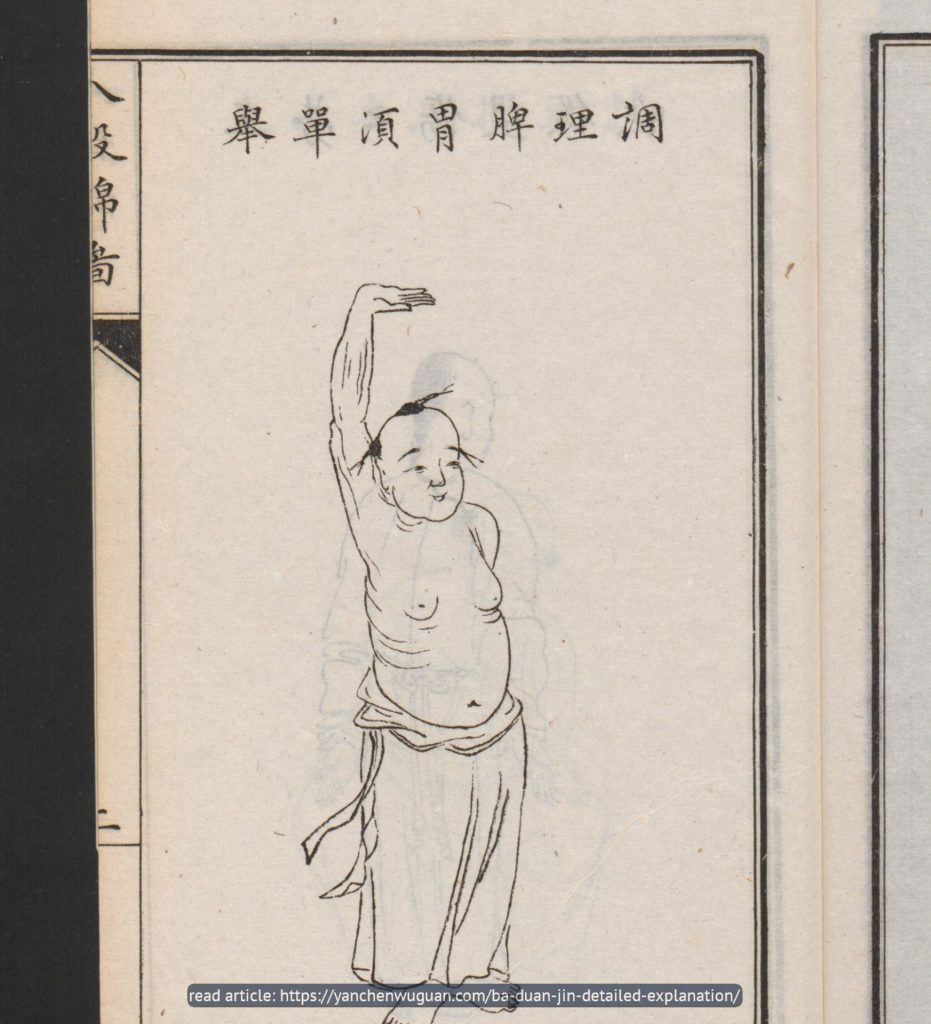
The main purpose of practicing this step is to heal the spleen and stomach. In order to be successful in this task, the practitioner must properly “raise an arm on each side,” as the name of the movement implies.
If the spleen and stomach function normally, the function and efficiency of body tissues and other organs will also be healthy. As a result, the human body as a whole will be less susceptible to disease.
According to Traditional Chinese Medicine, the spleen and stomach cannot stay healthy on their own. Proper nutrition, oxygenation, and efficient energy exchange are important.
This Baduanjin movement not only adjusts the spleen and stomach, but also regulates the liver and gallbladder. To perform it, raise one hand upward and lower the other hand downward with effort and push downward as if overcoming air resistance. The abdomen follows this movement and stretches, creating a “massage effect” for the spleen and stomach. At the same time, the meridians on either side of the chest are regulated. The thorax is believed to be the passageway of the liver and gallbladder meridians.
Effect: Through regulation of the liver, gallbladder and chest meridians, the internal organs involved in the process of digestion and cleansing are restored and improved.
Turn your head back to prevent illness and injury | 五劳七伤往后瞧
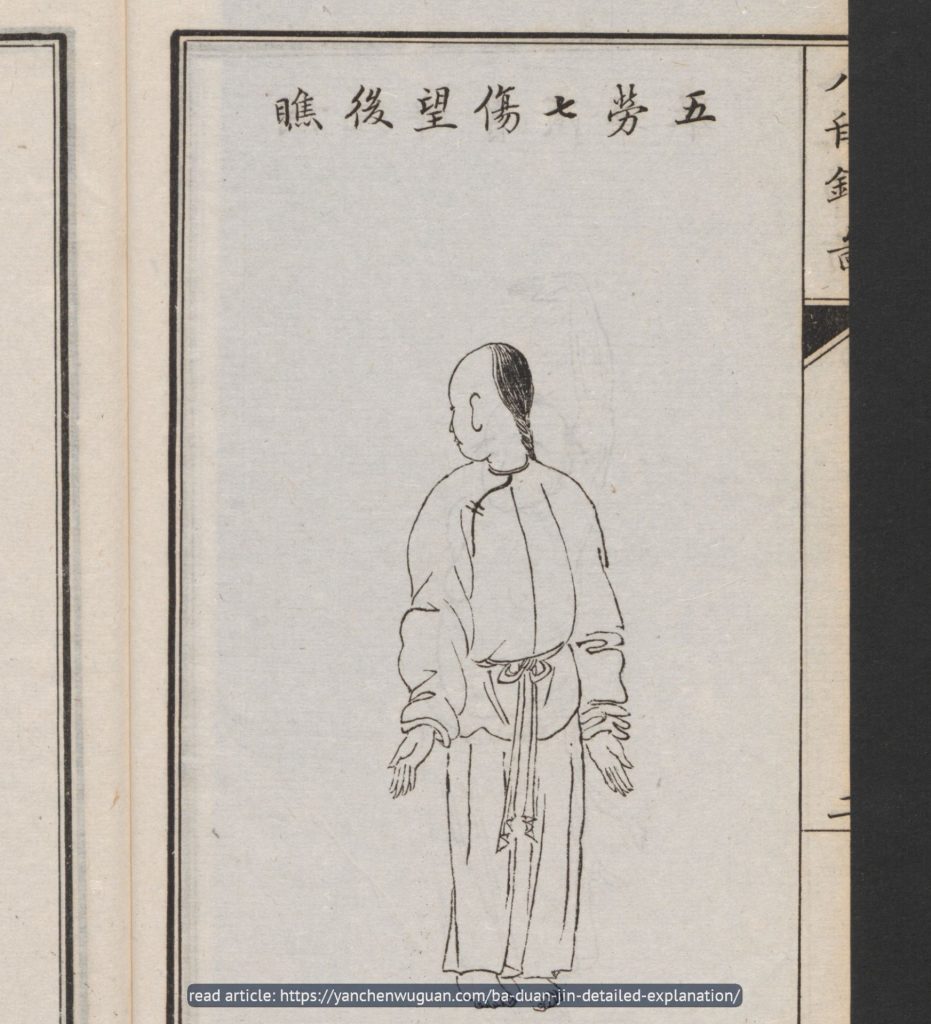
This step of the Baduanjin qigong complex is aimed at the overall health of the body.
Wulao qishang (wulao qishang, 五劳七伤) is a concept in traditional Chinese medicine that translates as “five weaknesses and seven injuries” and explains the causes of major internal diseases and disorders of the urinary tract.
Wulao refers to internal damage to the body: the liver, heart, spleen, lungs, and kidneys. It is expressed as follows: “Look too long and it will harm your blood; sit too long and it will harm your muscles; stand too long and it will harm your bones; walk too long and it will harm your tendons; lie too long and it will harm your qi. This means that looking, sitting, standing, walking, and lying down for too long is painful and has a negative effect on the body.
Qishan refers to external damage to the body caused by cold, heat, and improper lifestyles. Overeating, for example, damages the spleen, and anger causes damage to the liver. Sitting too long harms the kidneys, and drinking too many cold drinks harms the lungs. Sadness or excessive worry leads to heart disease. Wind, rain, cold, and heat take health away from the body. Being in fear or anxiety all the time traumatizes the spirit.
In Baduanjin, the movement “turn your head back to prevent disease and injury” is designed to deal with these five weaknesses and seven injuries. The physical purpose of this movement is to train the spinal cord. The spinal cord is very important, and all the yang energy of the body flows out of this point. To perform this movement correctly, practitioners must remember: When turning the head, you must look back, and the gaze must be directed to the back.
By looking back and focusing our gaze on our back, we twist our spinal cord, reinforcing the role of yang. This helps to prevent disease and external damage.
The second part of the movement is the rotation of the hand. The hand has six meridians, and the rotating movement helps to activate the yin-yang in these meridians.
Effect: With this step, we can prevent and cure the “five weaknesses and seven injuries”. The body twists to the right and left, increasing the mobility of the spine. The movement has a powerful positive effect on the circulatory system. Controlling one’s thoughts during the practice clears the jingle channels, making them flexible like silk.
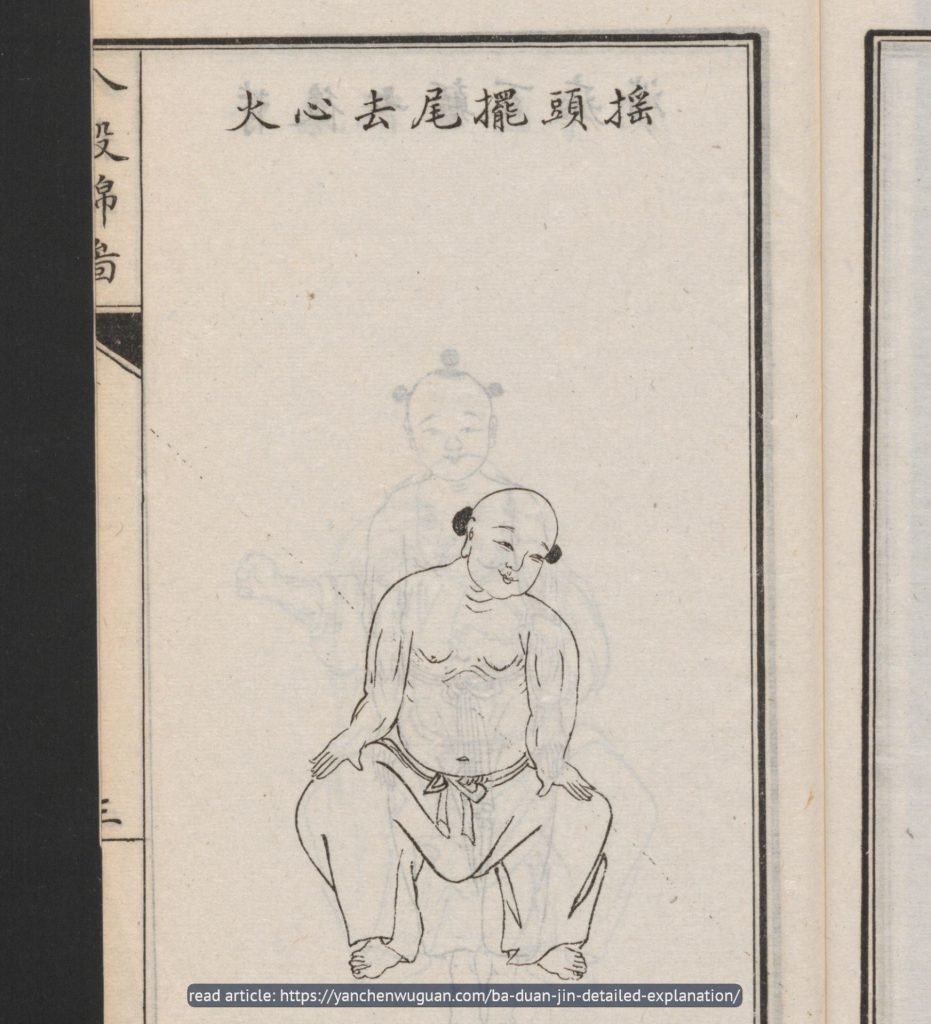
Shake your head and shake your tail to get rid of xinhuo symptoms | 摇头摆尾去心火
According to traditional Chinese medicine, xinhuo is the cause of disease and the cause of our susceptibility to illness, a concept literally translated as “heart fire. Exercise segments are designed both to maintain health and to heal the body.
This movement is used to prevent bladder and kidney disease, it stimulates the bladder to conduct renal qi and drain excess water. Because the range of motion and physical exertion of this movement is high, people with hypertension or the elderly should perform it in moderation.
Effect: The main goal is to balance the kidneys and heart to prevent the sinhuo symptom.
What is the meaning of xinghuo?
Chinese medicine studies the five internal organs and their relationship to the five elements (wood, fire, earth, metal and water).
Fire is directly related to the heart and also has two meanings: one meaning heat and the other meaning that heat can rise. When heat rises in the heart, one experiences the symptoms of xinhuo. To balance this heat, we must use the power of water (the kidneys). Water always goes down, but if there is too much of it, it causes the feet to become swollen and heavy. When the kidneys and heart are balanced, the body functions normally.
Two hands hold the legs to strengthen the kidneys and lower back | 两手攀足肾腰
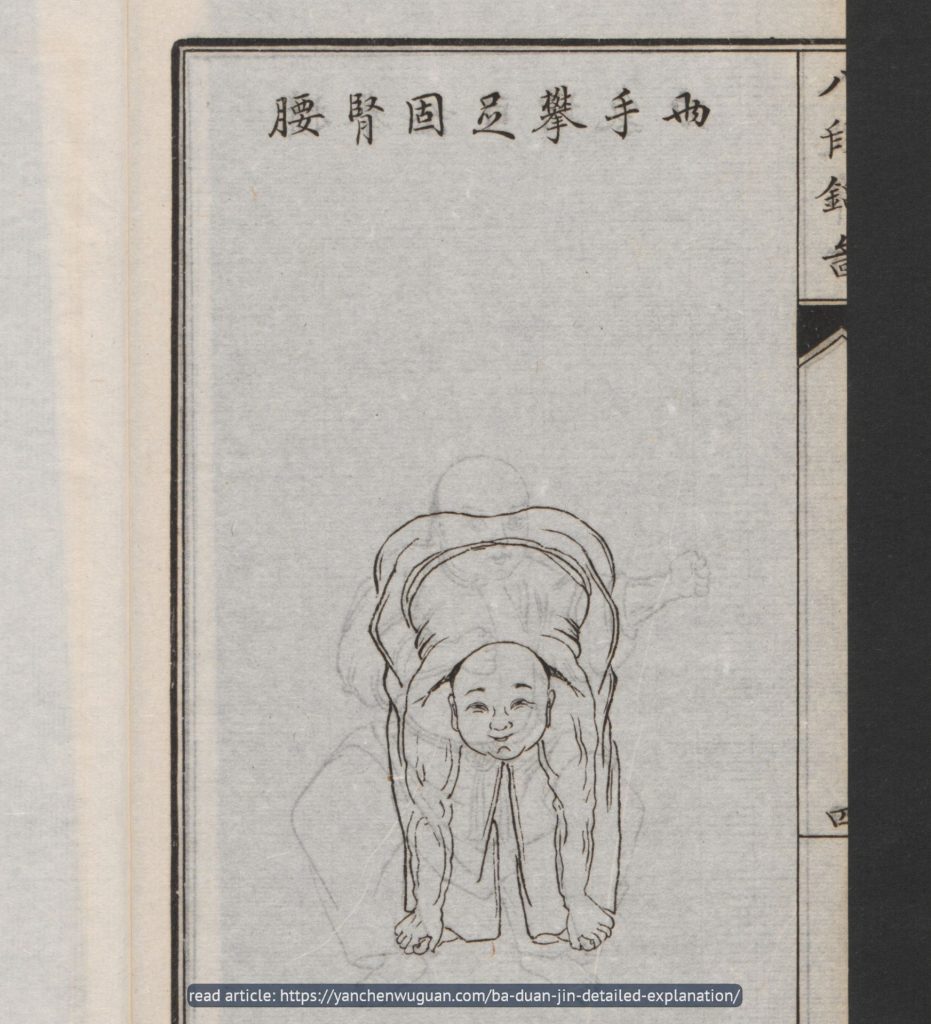
The sixth movement regulates and heals the body. To perform it correctly, the practitioner uses both hands to grip along the legs. The main purpose of the step is to strengthen the kidneys and lower back, and its concept is also based on Traditional Chinese Medicine’s theory of meridians.
According to Chinese medicine, the kidneys are located in the lower horizon and on either side of the spinal cord. Because of its location, the loin is often described as the “home” in which the kidneys are located. The primary function of the kidneys is to store essential qi, produce bone marrow and provide nutrition for the bones. They also absorb qi and water and balance yin-yang.
In traditional Chinese medicine, the kidneys are considered the element of water and if they lack the vital qi, the body’s bone system suffers. First of all the lower back. If the lower back is weakened, the body becomes more susceptible to illness and disease. And vice versa: the health of the kidneys can be judged by the strength of the lower back.
In the lower back area are several meridians such as the foot taiyang and dumai. At the back of the lower back are the Gates of Life. The Gates of Life and the Kidneys directly affect each other. If performed correctly, the movement creates a vertical massage effect and stretching of the back. The inhalation and exhalation stimulate the abdomen, lumbar muscles and meridians. The movement helps regulate qi and blood, improves the meridian system, and balances yin-yang.
When performing this movement, it is important that the hands and feet are in contact; this is the basis of the “heart and kidney crossing” method. In the middle of the palm there is a pressure point called laogong, and it is an important point of the xinbao meridian. On the soles of the feet there is a pressure point called yunquan, which is also the starting point of the kidney meridian.
The movement requires good flexibility, so the elderly or people with poor health (cardiovascular disease or cerebral circulatory disorders) should be careful and exercise slowly.
Effect: Movement helps regulate qi and blood, improves the meridian system, and balances yin-yang.
Clench your fists and look fiercely at those around you to improve strength and chi
| 攒拳怒目增气力
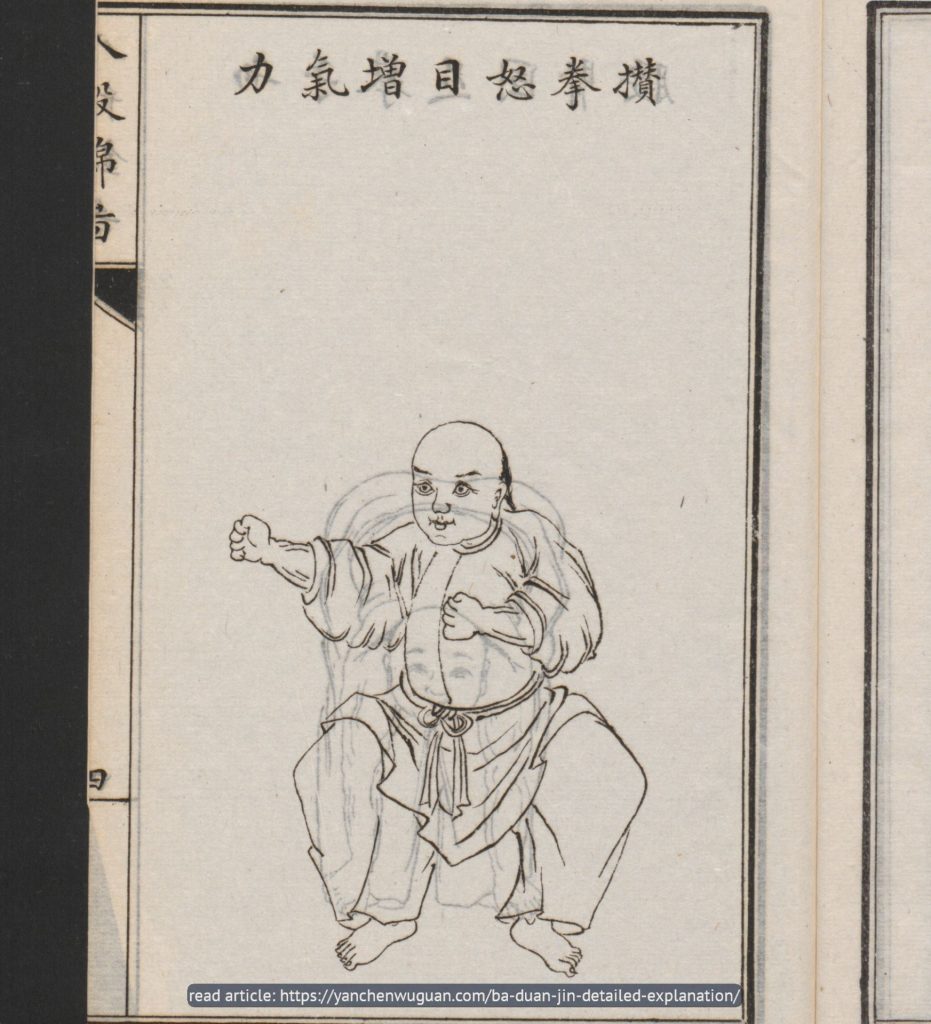
The movement is also based on the healing theories of Chinese medicine. Improving overall strength and qi is the main goal we seek to achieve by practicing this movement. The theory of this movement is based on the “five changes” in Chinese medicine.
According to Traditional Chinese Medicine, the main function of the liver is to preserve and maintain the availability of qi and blood. The liver influences blood flow and distribution in the body, spleen and stomach function, bile secretion and excretion, ejaculation in men and ovulation in women, regulation of emotions, etc.
A healthy liver ensures elasticity of tendons, improved hearing and overall performance of the human body. If there is enough liver blood, tendons are strong and nails are strong and shiny.
According to the “Five Elements” principle in Chinese medicine, changes in the liver are manifested when we clench our fists tightly. This means that when we are angry, our liver qi will circulate quickly, and the natural reaction to this will be to clench our fist. Changes in liver qi can also be reflected in our eyes.
The movement “Clench fists and stare fiercely to improve strength and qi” is based on natural human reactions, so practicing this movement is effective for improving health. The actions in this exercise include a horse stance, toes to the floor, clenched fists, and a fierce stare.
With constant practice, one can improve the condition of the tendons. Therefore, this exercise trains and improves not only the liver, but also the loins and kidneys, increasing overall strength and qi.
Effect: Improved overall strength and qi to improve health through liver work.
Fall seven times on your heels – dissolve all diseases | 背后七颠百病消
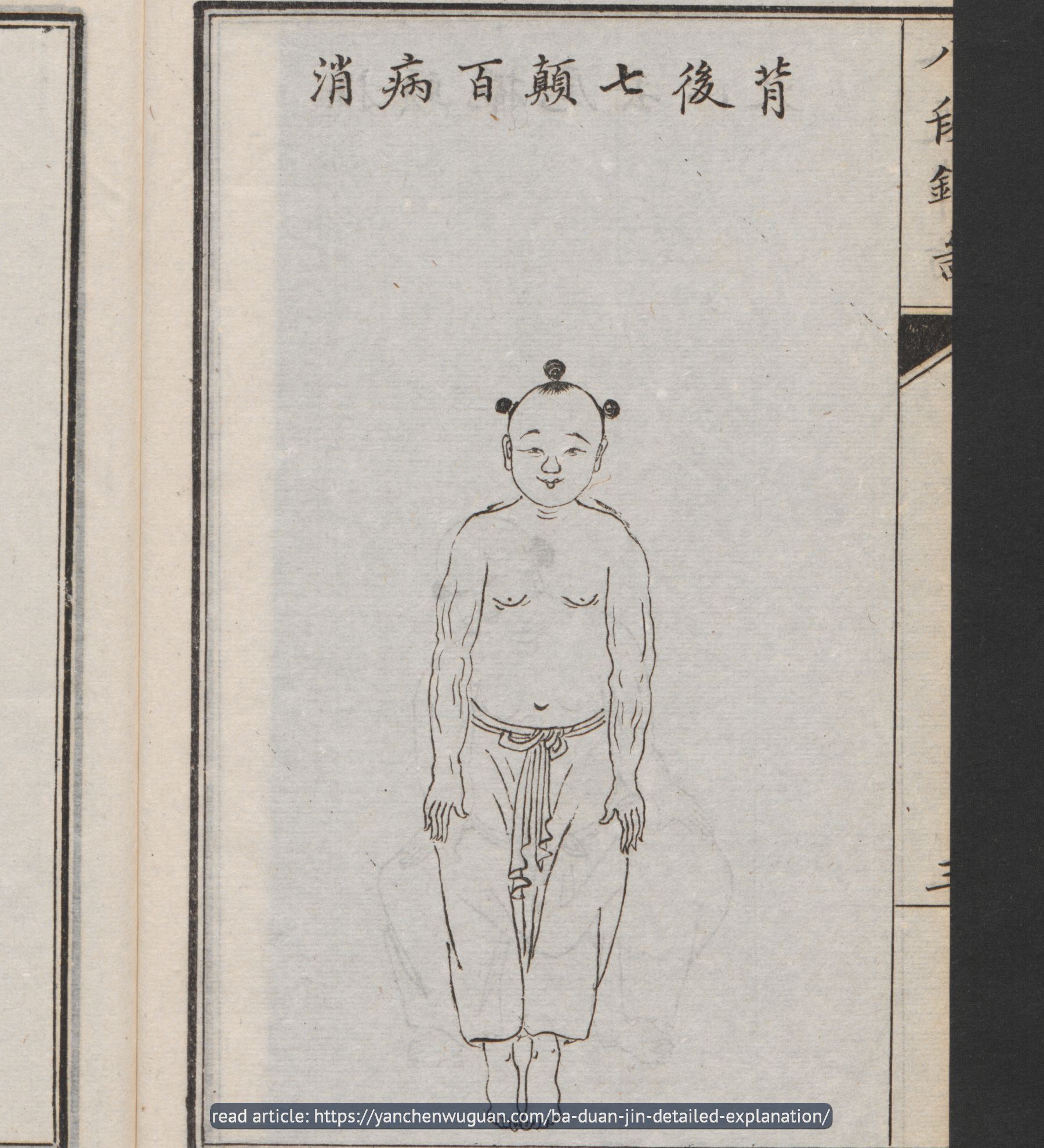
In this step, the movement “fall on your heels seven times – dissolve all diseases” requires the practitioner to lift his heels seven times, resting on his toes, and “throw” the body down by relaxation in order to protect the body from hundreds of diseases.
The main purpose of this exercise is to prevent most illnesses. The practice of “Fall seven times on your heels – dissolve all ailments” does not mean that if you do just this one exercise, all ailments will disappear. This is the final movement in Baduanjin and if you perform the previous 7 movements correctly and add this final step, you will protect your body from disease.
The segment of the movement consists of raising the heels up, creating a slight rocking motion in the ankle joint, and then abruptly lowering the feet. The three actions help treat and prevent hundreds of diseases: let’s analyze why.
According to Chinese medicine, when ten toes rest against the floor, it stimulates the six yin meridians and six yang meridians, which leads to the regulation of qi and blood and improves the function of the corresponding internal organs. In addition, bouncing on your feet can stimulate the dumai meridian, regulate the yin-yang balance in the body and promote healing and recovery.
Even those unfamiliar with traditional Chinese medicine know that dumai passes through the bao zhong and continues up to the huiyin pressure point. It then travels up the spinal cord, to the neck, to the head, up through it and then down to the upper lip. The path along which dumai goes is divided by branches that give qi to the kidneys and other important organs. dumai is closely connected with the brain, spinal cord and kidneys.
The first part of the word du (du, 督) literally means “the commander who controls the whole system. The dumai channel runs through the back and is in contact with the yang meridians of the arms and legs. It has a function of controlling and balancing the qi of the yang-meridians of the whole body. Therefore, it is called the commander and regulator of yang.
If we analyze this from the perspective of modern Western medicine: the spinal cord and nerves of the brain are in the center of the body, and the peripheral nerves that support the functioning of the internal organs branch off from it. The five organs of zang and the six organs of fu are influenced by the spinal nerve.
As the feet fall to the ground, energy travels upward, starting at the heels, to the joints, to the spine and then to the brain. This movement causes the spine to shake slightly and stimulates the body’s central nervous system. According to Chinese medicine, the energy transmitted by this movement causes the channel of dumai to vibrate. Since the channel affects the kidneys, the bouncing movement also stimulates the kidneys.
Effect: Stimulation of the central nervous system and kidneys of the body helps to improve the qi and blood of various internal organs, promotes the proper physiological functioning of internal organs, regulates the balance of yin-yang and promotes health.
Baduanjin’s health benefits
According to the theory of Chinese medicine, an indicator of good health is the unity and balance of the human body and spirit. This harmony of body and spirit is what we must achieve in order to stay or become alert and healthy. The benefits of the Baduanjin qigong complex are expressed in:
- regulating the breath to make this process smoother in the unity of mind and qi (breath),
- strengthening muscles and tendons to make the body more flexible.
Regular practice of Baduanjin helps to strengthen the spirit, support the body and preserve qi. These three elements are connected to each other and depend on each other. Qi (breath), body (form) and spirit (heart) together make up an organic whole. In order to be healthy, we must train our body, mind and breath to work in harmony. This is the kind of unity we should strive for when practicing kung fu.
More videos pls! text is hard to visualize moves lol
I appreciate your honesty here. The most important step is simply showing up to class. Hope to see you on the mats soon!
Great question, happy to help with this. It might feel difficult now, but consistency brings amazing results. Looking forward to training with you.
Nice post. Short. To the point. like it.
You are asking the right questions. We’d love to help you work on this specifically in class. Best regards on your path.
I love baduanjin but every time I do number 6 it aggravates my lower back. According to an x-ray I have a bulging disc. Any suggestions would be appreciated.
Paul
Hi Paul,
Thanks for reaching out. If exercise 6 in Baduanjin aggravates your back, it’s best to practice under the supervision of a master. Be sure to consult with your doctor before continuing.
Take care!
Merci de ces indications précises et précieuses, comme l’étoffe de Soie des Ba Duan Jin
De rien! Nous sommes ravis que vous trouviez nos informations précieuses. Si vous avez d’autres questions ou besoin de plus de détails, n’hésitez pas à nous contacter.
Question – how does this apply to real sparring? theory is nice but… …
It’s great to see your interest in the practice. Training is a journey, and everyone moves at their own pace. Feel free to drop by for a trial class anytime.
Excelente los artículos qué publican. Hay claridad y muy buena didáctica para aprender y enseñar Qi gong y Taichi. Muchas gracias!!